The Title X program was enacted on a federal level in 1970 as the only federal grant program dedicated to providing family planning care (United States Department of Health and Human Services [USDHHS], 2019). In the 1960’s, it became clear that unintended pregnancies could cause financial hardship and poor health outcomes among women living in poverty (Gold, 2001). It was necessary to find a means of providing family planning care to women who could not afford health insurance.
The Title X program is administered by the Office of Population Affairs, which is currently directed by Diane Foley, MD, FAAP (USDHHS, 2019). As Deputy Assistant Secretary, Dr. Foley directs the OPA in advising the Secretary and the Assistant Secretary for Health on many issues, including family planning, adolescent health, and sterilization (USDHHS, 2019). Dr. Foley spent many years working in pediatrics and has led medical missions to countries such as Haiti, Zambia, and Sierra Leone (USDHHS, 2019). In addition, she previously served as the President/CEO of an anti-abortion organization called Life Network, which provides financial and emotional support to women facing unintended pregnancies (USDHHS, 2019). The personal history of a political appointee such as Dr. Foley is important in policy-making, because when a high-level appointee takes an interest in a certain issue, the issue can suddenly be catapulted to prominence among members of the legislature (Kingdon, 2011).

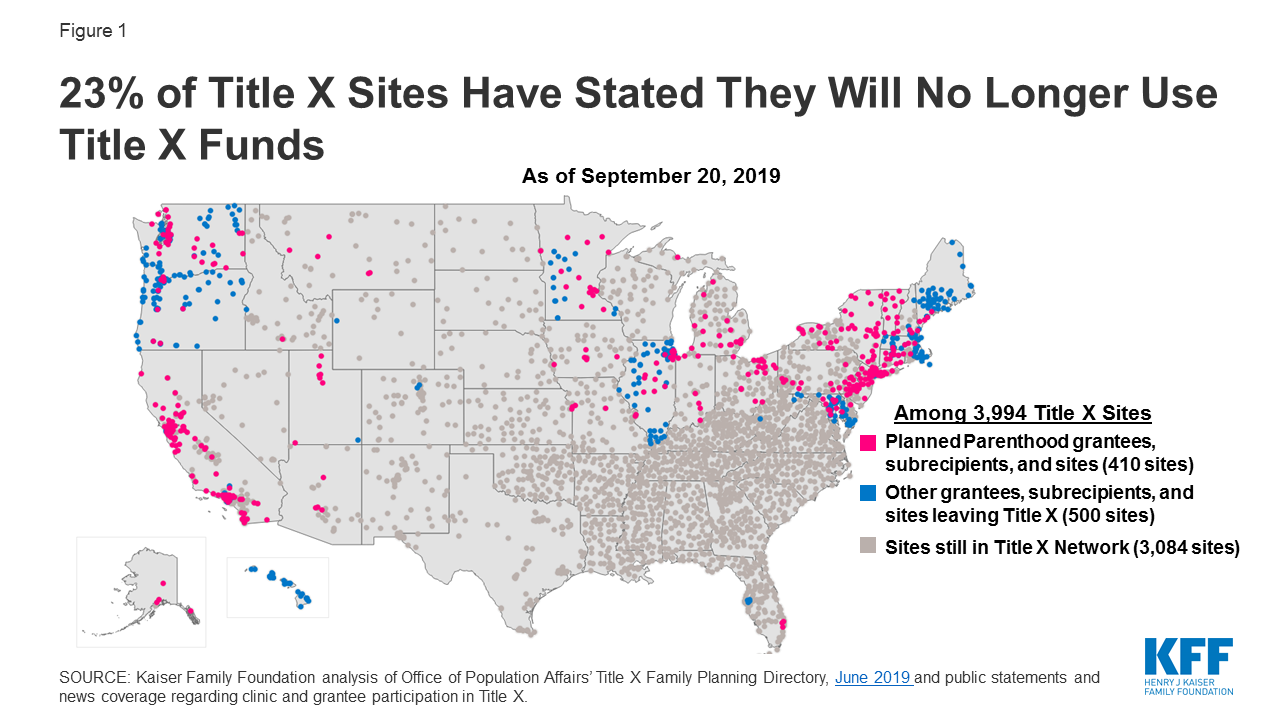
Of course, it is difficult to look up the Title X controversy of 2019 and not find information about Planned Parenthood. Planned Parenthood clinics were hit especially hard by the new regulations imposed on Title X funds because the new regulation requires both physical and financial separation from abortion services (Title X funds were never able to be used for abortion services, but now abortion services cannot take place in the same building as Title X services) (Frederiksen, Salganicoff, Gomez, & Sobel, 2019). The regulations imposed in 2019 on Title X funding cut off all Planned Parenthood centers from being able to use these funds, as it would have been an impossible undertaking to create a physical separation between all other services Planned Parenthood provides and their abortion services (Frederiksen, Salganicoff, Gomez, & Sobel, 2019). However, these attempts to undermine Planned Parenthood were not the first of their kind. As Florida State University law professor Mary Ziegler explains, Planned Parenthood has been under fire by the government since the time of the Reagan administration (Kelly, 2018). For a very brief time in 1992, the first attempt at a gag rule on Title X was in effect before being rescinded by President Clinton in 1993 (National Family Planning & Reproductive Health Administration [NFPRHA], 2017). Currently, 23% of sites previously using Title X funding have removed themselves from the program (Frederiksen, Salganicoff, Gomez, & Sobel, 2019).
On a state level, the Arizona Family Health Partnership (AFHP) has been the recipient of the Title X Grant in Arizona since 1983, and partners with 7 different agencies to support access to free family planning care (AFHP, 2019). The AFHP is a non-profit organization, first established in 1974, which serves over 36,000 patients a year in Arizona (AFHP, 2019). The current president of the AFHP is Audra Koester Thomas, who has graduate degrees in public administration and political science from the University of Houston (Thomas, 2019). She is currently the manager of Transportation Planning for Maricopa County and a court appointed special advocate for children in the foster system (Thomas, 2019). As a civil servant, she has the ability to foster relationships with members of the government and the potential to influence the growth of policy proposals, but she has much less influence than an appointed official (Kingdon, 2011).

This week, I had the opportunity to attend the March of Dimes’ Day at the Capitol. Although the Title X regulations were created at the federal level, it was eye opening to see the process of bills being discussed and passed through various levels of the government on a state level. The process seems cumbersome and complicated, so I can only imagine how complicated it might get when creating laws on a federal level.
Healthcare providers also have the ability to influence policy, and must not be forgotten as key players in this game. According to Inouye, Leners, and Miyamoto (2019), a nurse’s most influential way to exert political capital is by using grassroots efforts. The workforce of registered nurses far exceeds the workforce of other health professions, with nurses outnumbering physicians by 314% (Inouye, Leners, & Miyamoto, 2019). Just imagine if every nurse advocated for the health policy that he or she believes in. The regulations imposed on Title X in 2019 are restricting patient access to essential information and care, as described in my previous blog posts. If you are one of the many healthcare professionals opposed to these regulations, I encourage you to make your voice heard through avenues such as the Arizona Nurses’ Association’s Public Policy Committee or by supporting the Arizona Family Health Partnership.
References
- Arizona Family Health Partnership [AFHP] (2019). Title X’s impact in Arizona/Dollars and sense of Title X. Retrieved from https://www.arizonafamilyhealth.org/wp-content/uploads/2019/05/TitleX-For-Web.pdf
- Frederiksen, B., Salganicoff, A., Gomez, I., & Sobel, L. (2019, September 20). Data note: Impact of new Title X regulations on network participation. Retrieved from https://www.kff.org/womens-health-policy/issue-brief/data-note-impact-of-new-title-x-regulations-on-network-participation/
- Gold, R.B. (2001). Title X: Three decades of accomplishment. The Guttmacher Report on Public Policy, 1-8. Retrieved from https://www.guttmacher.org/sites/default/files/article_files/gr040105.pdf
- Inouye, L., Leners, C., & Miyamoto, S. (2019). Building capital: Intellectual, social, political, and financial In R.M. Patton, M.L. Zalon, & R. Ludwick (Eds.), Nurses Making Policy from Bedside to Boardroom (2nd ed.), (pp. 195-224). New York, NY: Springer.
- Kelly, M.L. (Host). (2018, May 18). The History of Title X Throughout U.S. History [Radio broadcast episode]. Retrieved from https://www.npr.org/2018/05/18/612441155/the-history-of-title-x-throughout-u-s-history
- Kingdon, J.W. (2011). Participants on the inside of government In J.W. Kingdon (Ed.), Agendas, Alternatives, and Public Policies (2nd ed.) (pp.21-44). Glenview, IL: Pearson.
- National Family Planning & Reproductive Health Association [NFPRHA]. (2017). Domestic gag rule fact sheet. Retrieved from https://www.nationalfamilyplanning.org/file/Domestic-Gag-Fact-Sheet.pdf
- Thomas, A.K. User Profile. LinkedIn. Viewed 12 Feb, 2020. https://www.linkedin.com/in/akoesterthomas
- United States Department of Health and Human Services [USDHHS]. (2019). Office of Population Affairs. Retrieved from https://www.hhs.gov/opa/
 DNP 711 Health Policy
Hi Edie,
What a terrific blog you’ve written. You’ve provided a comprehensive, balanced, just-the-facts historical summary of how we find ourselves here, still fighting for reproductive rights after all these years. I agree with your insight that the person who is the agency administrator — his or her qualifications, personal values, and work history — largely defines what happens in an agency, and at what speed.
I am in my 60s now, but I still remember the very specific days when, as a college student, I needed abortion counseling and services. I lived in Berkeley and it was easy for me to find a Planned Parenthood location and learn what I needed to know. It wasn’t easy for me to decide what to do, but Planned Parenthood gave me the most important ingredient for making a good decision: accurate information.
Growing up in Arizona, I knew women who, as teenage girls, had only three bad options for addressing unwanted pregnancy: going to Mexico, going to underground health providers, or being treated as an object of shame at the Crittenton home in Phoenix. This article in the Washington Post from last November is a comprehensive, and sad, history of the Crittenton philosophy and its repercussions, many of which were true for a friend of mine at Crittenton. https://www.washingtonpost.com/history/2018/11/19/maternity-homes-where-mind-control-was-used-teen-moms-give-up-their-babies/
But on the bright side, we have Planned Parenthood today, despite all the efforts to wrest control from women over their reproductive health. In 2018 I attended the ‘Stand With Planned Parenthood’ spring event, where I first learned about Planned Parenthood’s Latinx organization Raiz, and the young women and men who are the power behind it. At the time, I was recruiting for an ASU research study around breast cancer survivorship, and we were specifically trying to enroll Spanish-speaking cancer survivors. I contacted Raiz for help and suggestions, which was where I met Norma and Victoria, who are both profiled here. They are amazing young women with boundless energy. We shared recruitment tables at Latino events and they made themselves available if we needed translation services. Just reading their descriptions of why, when, and where each came to feel a calling to Planned Parenthood is inspiring.
Just in case you want to make a connection between nursing advocacy and the energetic power of young people, here’s the link:
https://www.plannedparenthoodaction.org/blog/justice-knowledge-and-power-meet-the-people-of-raiz-2
LikeLike
Thanks for sharing a detailed history on Title X. I learned a lot about Title X from reading your blog post. You reported an interesting fact that 23% of sites that formally used Title X, are no longer using it (Frederiksen, Salganicoff, Gomez, & Sobel, 2019). If these agencies are no longer using Title X, are they still providing affordable contraception and reproductive healthcare? Do these organizations receive funding from other sources? Will the patients receiving care at these sites suffer or benefit from the organization not receiving Title X?
I think it could possibly be both. In some instances, it could benefit the patient because they are able to receive quality counseling and information on abortion services but in other instances it could increase the out of pocket costs for contraception and reproductive healthcare (Sadeghi & Wen, 2019). This may result in patients discontinuing their contraception or patient not receiving access to reproductive healthcare because of the cost (Sadeghi & Wen, 2019).
Reference
Frederiksen, B., Salganicoff, A., Gomez, I., & Sobel, L. (2019, September 20). Data note: Impact of new Title X regulations on network participation. Retrieved from https://www.kff.org/womens-health-policy/issue-brief/data-note-impact-of-new-title-x-regulations-on-network-participation/
Sadeghi, N. B., & Wen, L. S. (2019). After title X regulation changes: Difficult questions for policymakers and providers. Retrieved from https://www.healthaffairs.org/do/10.1377/hblog20190923.813004/full/
LikeLike